How to Choose a Pressure Gauge for a Small Workshop
By Martin Douglas · Published · Updated · 5 min read
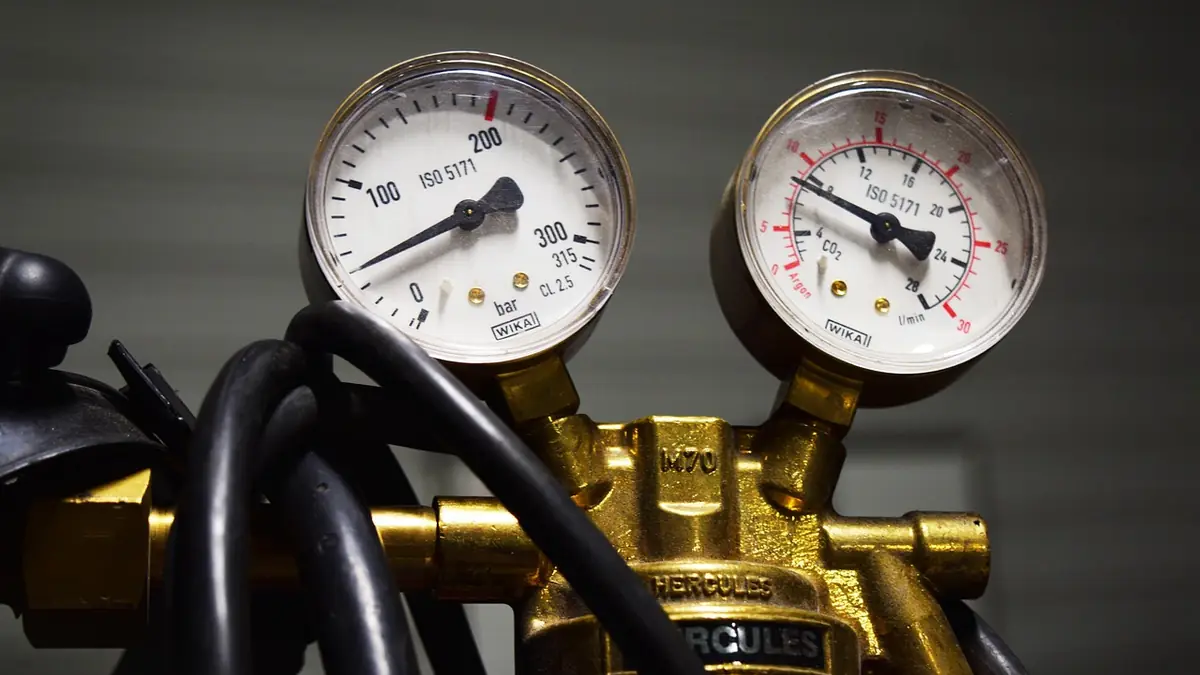
Most small workshops buy pressure gauges the way they buy fuses: grab whatever is on the shelf in roughly the right size. That works until a gauge is pegged against its stop pin on a compressor line, or a £15 unit on a hydraulic test rig reads 4 bar when the real figure is 5.5. Neither failure is dramatic, but both cost time and, occasionally, a damaged component.
Gauge selection comes down to a handful of decisions: pressure range, accuracy class, connection thread, fill fluid, and wetted materials. Get those five right and the gauge will last years. Get them wrong and you will either replace it annually or trust a number you shouldn't. This guide walks through each choice with the numbers that actually matter in a workshop setting.
Start With the Range, Not the Dial Size
The single most common mistake is buying a gauge whose full scale sits close to normal operating pressure. A gauge should read at roughly the middle of its scale during normal operation, with the working pressure ideally between 25% and 75% of full scale. A compressor that runs at 8 bar wants a 0–16 bar gauge, not a 0–10 bar one that sits permanently near the top of the dial where accuracy degrades.
Oversizing is equally wasteful. A 0–60 bar gauge on a 6 bar line compresses the useful part of the scale into the first tenth of the dial, and a 2.5% full-scale error becomes a 1.5 bar uncertainty on a reading of 6 bar. For most workshop air and water lines, a gauge whose span is about twice the normal working pressure is the sweet spot.
Also check the overpressure limit in the datasheet. Better gauges tolerate 130% of full scale briefly and around 110% continuously, which matters on lines with pressure spikes from a quick-acting valve or a pump start.
- Working pressure at 25–75% of full scale
- Span roughly 2× normal operating pressure
- Confirm continuous and brief overpressure limits
- Use a higher range, not a bigger dial, for spiky lines
Accuracy Class: What the Number Really Means
Accuracy class on an analogue gauge is expressed as a percentage of full scale, not of the reading. A 2.5% class gauge on a 0–16 bar dial can be off by ±0.4 bar anywhere on the scale. A 1.6% class gauge cuts that to ±0.26 bar, and a 1.0% class to ±0.16 bar. The distinction matters most at the low end of the scale, where a percentage-of-full-scale error is proportionally largest.
For general workshop air, water, and coolant lines, 2.5% class is usually adequate. For hydraulic test rigs, leak-down testing, or anything where you record readings against a specification, move to 1.6% or 1.0%. Note that accuracy classes are quoted at room temperature; a gauge specified at 20 °C will drift as the workshop warms, typically by around 0.4% of full scale per 10 °C away from the reference temperature.
If you need better than 1.0%, you are usually into test-gauge territory with mirrored scales and knife-edge pointers, and the price steps up sharply.
- Class is % of full scale, not % of reading
- 2.5% class: general air and water lines
- 1.6–1.0% class: test rigs and recorded readings
- Allow for temperature drift away from 20 °C
Connection Size, Thread, and Mounting
The most common workshop connection is 1/4" BSPP (parallel) for small air lines and 1/2" BSPP for larger water and process lines. NPT threads appear on imported equipment and on some hydraulic components, and the two are not interchangeable: forcing an NPT gauge into a BSPP port will damage the thread and often leaks. Check the port before ordering, and keep a thread gauge in the drawer.
For anything above about 16 bar, or on lines with vibration, use a 1/2" connection even if 1/4" would physically fit. Larger threads spread the load and accept a proper sealing washer. Below 10 bar on air, a 1/4" connection with a bonded seal is fine.
Mounting matters too. Direct-mounted gauges on vibrating compressors die young; a 2 m capillary or a panel mount with a rubber-backed bracket isolates the movement and is worth the extra cost.
When you are specifying several instruments at once, it pays to read the port and material details on the datasheet carefully rather than inferring them from a photo; our guide on how to read a technical data sheet without missing specs covers the fields people skip.
Glycerin Fill, Dampening, and Vibration
A dry gauge on a pulsating line will have a needle that vibrates so hard you cannot read it, and the movement wears out quickly. Glycerin-filled gauges damp the needle and lubricate the movement, typically extending service life several-fold on compressor and pump discharge lines. The trade-off is temperature: glycerin thickens in cold conditions and the gauge becomes sluggish below roughly 0 °C.
Silicone fill handles wider temperature ranges, from about −40 °C to 150 °C, and is the better choice for outdoor or unheated installations. For clean, steady lines, a dry gauge is cheaper and perfectly adequate. If the needle still flutters with fill, add a snubber or a restrictor screw at the inlet rather than going up a price band.
Filled gauges need a small vent plug, usually a coloured bung at the top of the case, opened slightly after installation to equalise case pressure. Forgetting this is a common cause of apparently erratic readings.
- Dry: steady lines, indoor use, lowest cost
- Glycerin: vibration and pulsation, above 0 °C
- Silicone: wide temperature range, outdoor use
- Add a snubber if flutter persists with fill
Wetted Materials and the Medium
Brass is the default wetted material for air, water, and neutral oils up to about 25 bar, and it is inexpensive and reliable. Stainless steel (usually 316L) is the choice for anything involving aggressive coolants, mild chemicals, seawater, or food-contact lines, and it handles higher pressures in the same case size.
For ammonia, certain refrigerants, and oxygen service, the material choice is not optional and neither is the fill: oxygen service requires a cleaned, oil-free gauge, and ammonia attacks brass. If you are unsure, check the medium against a compatibility table before ordering rather than after the gauge fails.
Diaphragm seals are the answer for dirty, viscous, or crystallising media, isolating the gauge movement behind a flexible membrane. They add cost and a small response lag but prevent the blocked-port failures that plague slurry and adhesive lines.
Gauges on field equipment also face dust and washdown. If your instruments live outdoors or get hosed down, understanding IP ratings on field instruments will help you match the enclosure to the environment instead of guessing.
| Application | Range (bar) | Accuracy class | Connection | Fill / material |
|---|---|---|---|---|
| Compressor air line | 0–16 | 2.5% | 1/4" BSPP | Glycerin / brass |
| Hydraulic test rig | 0–100 | 1.6% | 1/2" BSPP | Glycerin / stainless |
| Coolant circulation | 0–6 | 2.5% | 1/4" BSPP | Dry / brass |
| Water supply header | 0–10 | 1.6% | 1/2" BSPP | Dry / brass |
| Outdoor pump discharge | 0–25 | 1.6% | 1/2" BSPP | Silicone / stainless |
| Leak-down test bench | 0–4 | 1.0% | 1/4" BSPP | Dry / stainless |
Calibration, Marking, and Replacement
Any gauge used for a recorded reading or a safety decision should be checked periodically. A practical workshop interval is every 6–12 months for gauges on test rigs and every 2 years for general utility lines, checked against a known reference or a deadweight tester. Gauges with a zero-adjust screw can be trimmed; sealed ones cannot and should be replaced once they drift beyond their class.
Mark the normal operating band on the dial with a coloured clip or a paint pen. It sounds trivial, but it lets anyone walking past see at a glance whether a line is where it should be, and it turns a gauge into a quick visual check rather than a number to interpret.
Log the purchase date and any calibration checks. A simple written record makes replacement cycles predictable, and the approach in setting up a basic instrument maintenance log works as well for a dozen gauges as for a full plant.
- Size the range so normal working pressure falls at 25–75% of full scale.
- Accuracy class is a percentage of full scale, so it matters most at low readings.
- Match thread type exactly (BSPP vs NPT) and go up a size above 16 bar.
- Use glycerin or silicone fill on vibrating lines, and open the vent plug after fitting.
Martin has spent years writing about measurement equipment and helping small workshops choose and maintain the right instruments. He focuses on practical buying advice, calibration routines, and clear explanations of specification sheets. His goal is to make instrument decisions easier for people without a metrology background.